
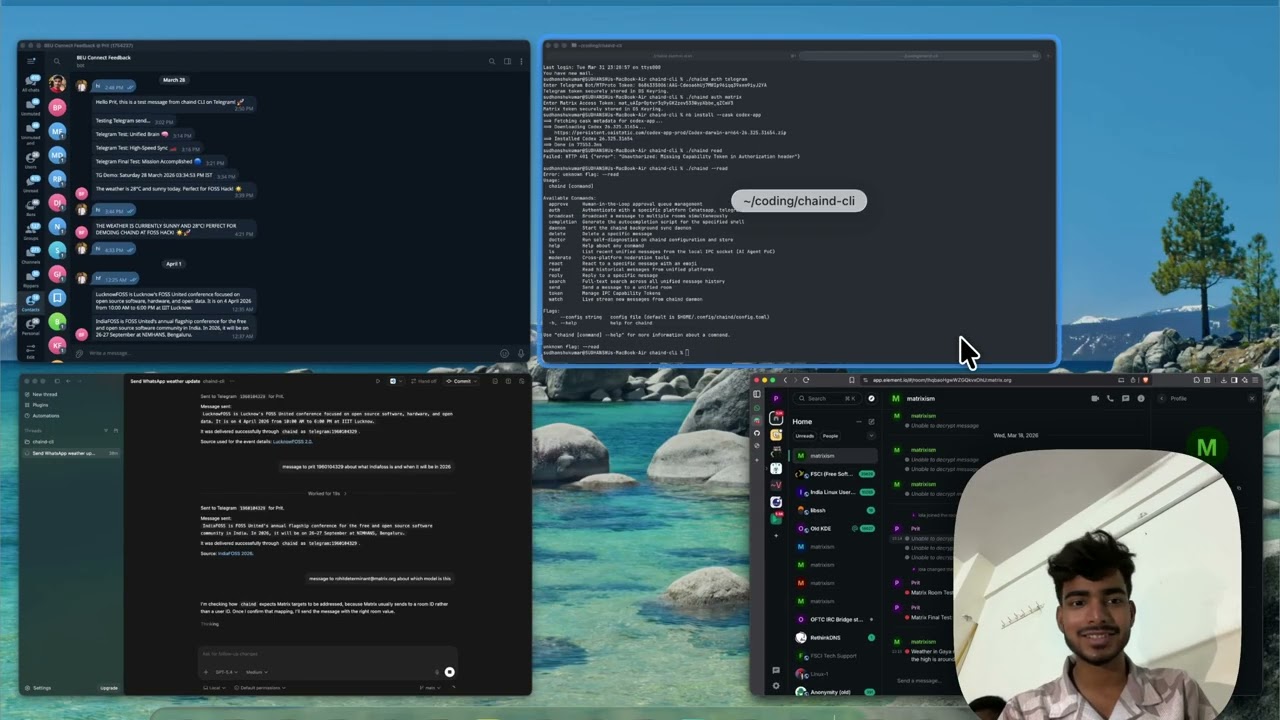
A chatbot should not mean “someone else’s server sees all my messages”. That’s the thought behind chaind, a Go daemon I co-built with fossism that bridges Telegram, Matrix, and WhatsApp to local AI agents over a permission-gated Unix socket.
The idea: your messages stay on your machine. An agent daemon listens on a local socket, and only the bridges you explicitly allow can talk to it. No cloud round-trip for your chat history — the socket is the privacy boundary.
What made this fun to build:
We shipped the status command and socket error handling first — boring plumbing, but it’s what makes a daemon reliable instead of a demo.
It’s AGPL-3.0 licensed and lives at fossism/chaind-cli. If you’ve ever wanted your Telegram bots to be actually yours — this is the direction.
Co-building it also reminded me why I love FOSS: two people, different time zones, one shared repo, and the best ideas come from arguing about the design in the README.
Internships, open-source, privacy tooling, community work — if you're building something interesting, my inbox is open.
